


How to Choose a Shopify Management Agency in the USA
The best Shopify management agency for a US store combines e-commerce-specific expertise with documented revenue results and reporting that connects straight to return on ad spend, conversion rate, and customer acquisition cost. Because Shopify now holds close to 30% of the US e-commerce platform market and powers roughly 3 million American storefronts, the team running a store matters more than the platform beneath it. Compare at least three agencies on track record, scope, and pricing before you sign anything.
A Shopify Management Agency Runs the Growth Work an Owner Cannot
A Shopify management agency handles the operational and strategic work behind a storefront, spanning site management, e-commerce SEO, paid media on Google and Meta, conversion rate optimization, retention, and marketplace channels like Amazon. The strongest firms treat these functions as one connected revenue system rather than separate line items.
The distinction that matters most is specialization versus generalization, because a general digital agency tends to treat a Shopify store as a brochure website that merely happens to accept payments. A genuine specialist reads the product page, checkout flow, and cart abandonment as linked levers, where a change to one shifts the others. Cybez, for instance, calls itself a niche e-commerce marketing and consulting company rather than a full-service shop, and frames the engagement as a partnership rather than a vendor arrangement.
Scope also varies more than most owners expect, since some firms stop at media buying while others consolidate Shopify development, SEO, competitive intelligence, and retention under one roof, and an owner juggling four separate freelancers usually loses more in coordination than a single accountable team would cost.
Name Your Top Three Problems Before You Shortlist Anyone
Before contacting a single agency, an owner should write down the three problems draining the most money, because slow load times, high ad spend with thin returns, and unexplained cart abandonment each call for a different specialist. The wrong match can burn an entire quarter of growth.
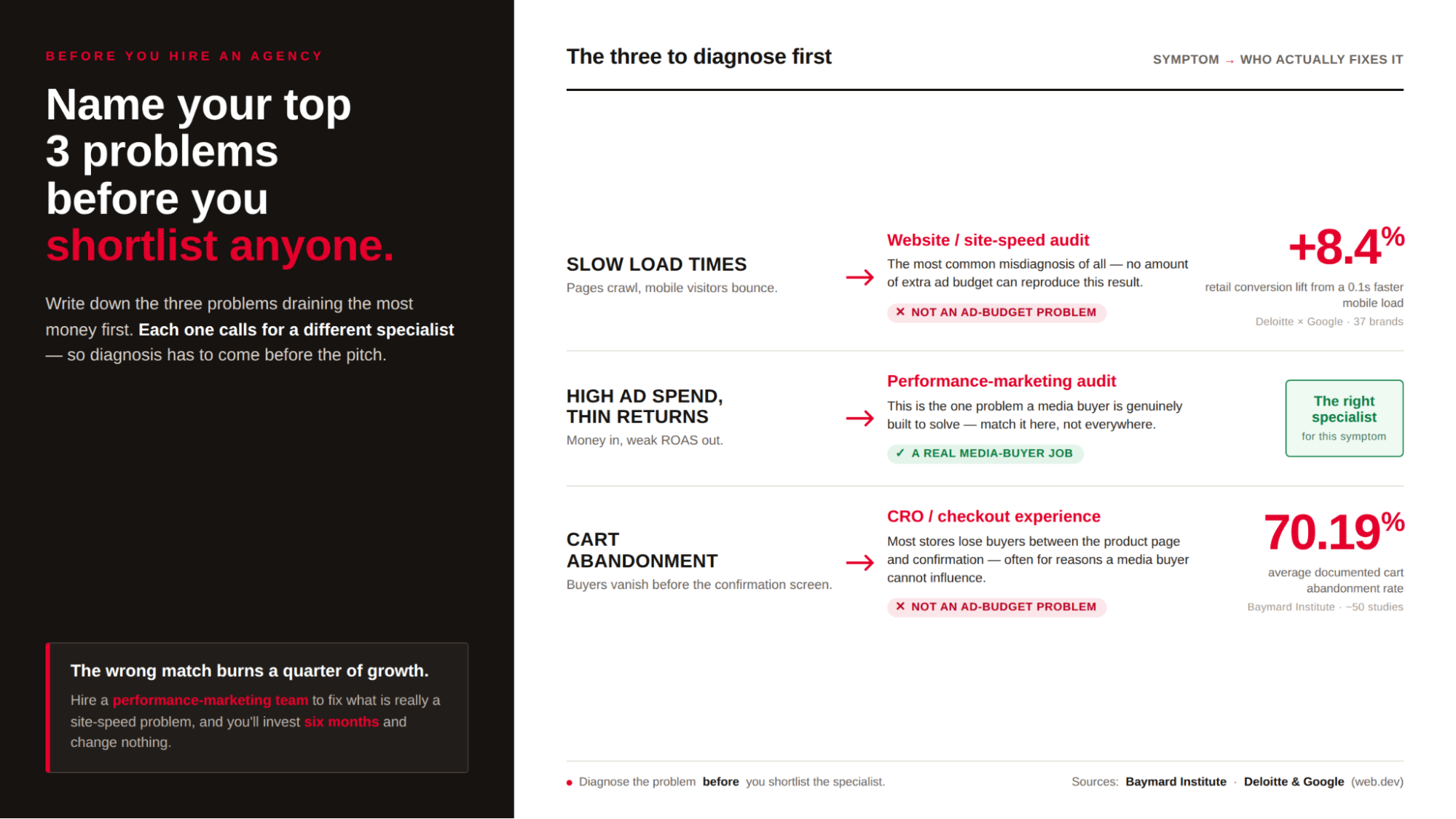
Diagnosis has to come before the pitch, since an owner who hires a performance-marketing team to fix what is really a site-speed problem will invest six months and change nothing. Baymard Institute puts the average documented cart abandonment rate at 70.19%, drawn from roughly 50 studies, which indicates most stores lose buyers somewhere between the product page and the confirmation screen, often for reasons a media buyer cannot influence.
Site speed is the most common misdiagnosis of all. A Deloitte and Google study of 37 brands found that a 0.1-second improvement in mobile load time lifted retail conversions by 8.4%, an outcome no amount of additional ad budget can reproduce.
Matching a store’s core problem to the right kind of agency
| Primary problem | Agency type to hire | Metric to track |
| Slow site, technical bugs | Shopify development agency | Largest Contentful Paint (LCP) |
| High ad spend, low return | Performance marketing agency | Return on ad spend (ROAS) |
| High traffic, low sales | CRO-focused agency | Conversion rate |
| Low repeat purchase rate | Retention marketing agency | Customer lifetime value (CLV) |
| Verdict | Match the agency to the leak, not the trend | Track the paired metric weekly |
Documented Case Studies Separate Real Agencies From Confident Claims
Ask for client results tied to a named brand, a specific figure, and a defined time frame, because generic testimonials of the ‘great team, great results’ kind say nothing a landing page could not. Quantified outcomes attached to a real brand are the credential that counts.
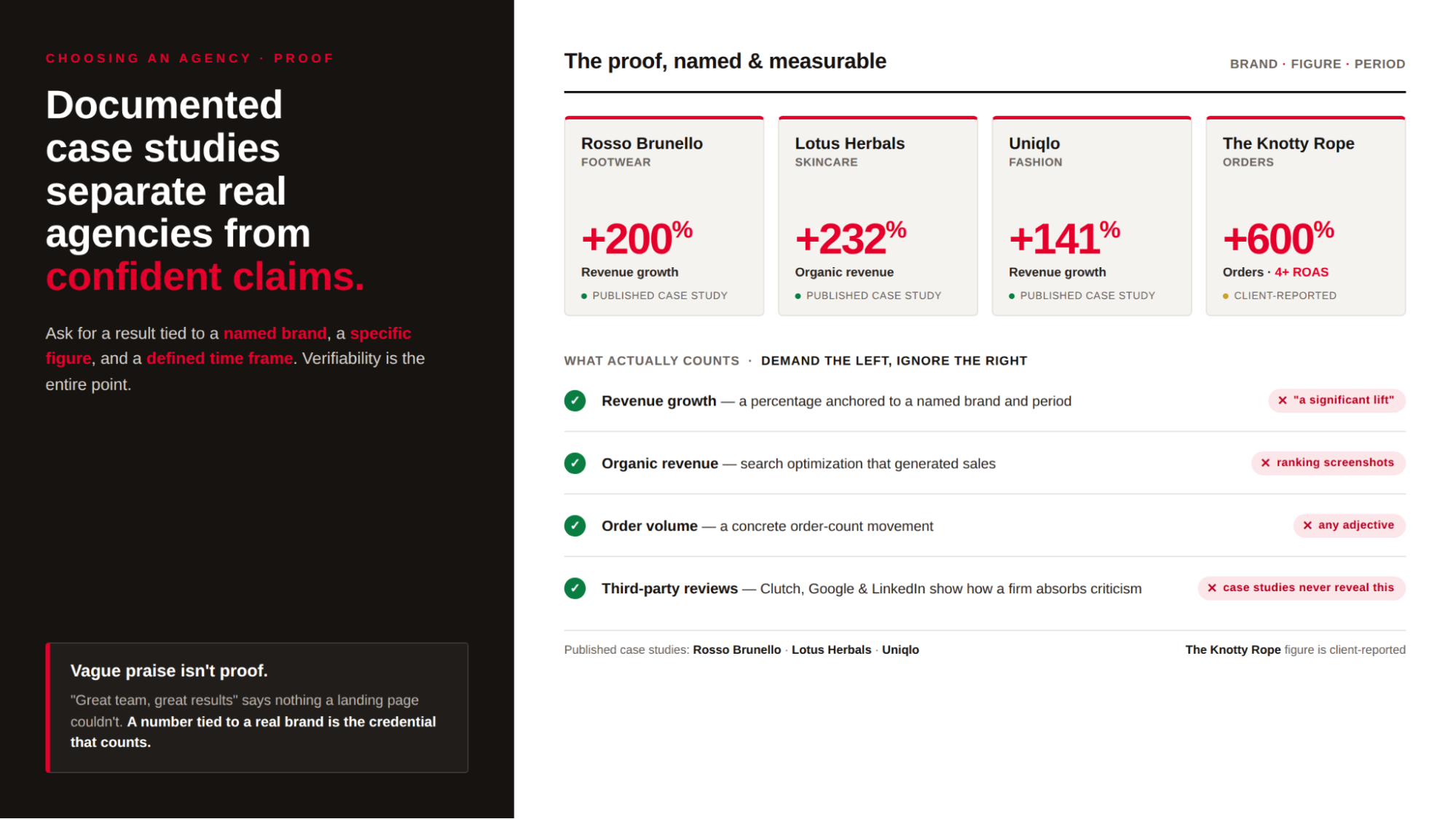
Verifiability is the entire point, and an agency that can reference a footwear brand growing revenue 200%, a skincare brand adding 232% in organic revenue, or a fashion label reaching 141% revenue growth is demonstrating measurable outcomes tied to real accounts. Cybez publishes these three as Rosso Brunello, Lotus Herbals, and Uniqlo, alongside client-reported figures such as The Knotty Rope’s 600% jump in orders at a 4-plus ROAS.
- Revenue growth: a percentage anchored to a named brand and period, never a vague ‘significant lift’
- Organic revenue: search optimization that generated sales rather than ranking screenshots
- Order volume: a concrete order-count movement outweighs any adjective
- Third-party reviews: Clutch, Google, and LinkedIn expose how a firm absorbs criticism, which case studies never reveal
Conversion Rate Optimization Moves Revenue Faster than Traffic
Traffic without conversion produces no revenue, and lifting a store from a 1% to a 1.5% conversion rate adds 50% more revenue from the same visitors and the same ad spend. That is why conversion rate optimization deserves scrutiny before another dollar reaches the media.
The mathematics compound quietly, because Baymard Institute estimates that better checkout design alone could recover approximately $260 billion in lost orders across the US and EU, and that the average large store can increase conversions by roughly 35% through checkout improvements. Yet many owners keep purchasing traffic into a leaking funnel, since fresh sessions feel like progress in a way a checkout audit does not.
Effective CRO is continuous, not a one-off report, so a disciplined program runs A/B tests, reviews session recordings, and audits the checkout on a set cadence. Cybez cites a client, Trendia, whose conversion rate climbed from 0.77% to 1.16% after interface and experience changes, a movement that roughly doubled the value of the traffic already arriving.
Confirm Scope, Ownership, and Reporting Before You Sign
Shopify management covers a broad range of tasks, so the contract must state who owns the account, which tools the team uses, how often they report, and what their CRO process involves. A firm that cannot answer these four questions in plain language is a warning sign.
Category range matters considerably here too, because a supplement store behaves nothing like a furniture retailer, yet a firm exposed to fifteen or more industries has usually resolved a version of the problem previously. Cybez reports work across 15-plus industries and more than 350 delivered projects, the kind of accumulated breadth that shortens the learning curve on an unfamiliar account.
- Account ownership: who is the designated account manager, and what is their direct line of contact?
- Tool stack: which platforms handle analytics, heatmaps, and ad management, GA4 and what beyond it?
- Reporting cadence: how frequently do reports arrive, and in what format?
- CRO process: do they test, audit checkout, and review recordings on a schedule, or only at kickoff?
Google and Meta Management Should Optimize Toward Profit, Not Clicks
Paid media on Google and Meta can scale a store or drain it inside a quarter, and the operator decides which. Ask whether the agency optimizes toward ROAS or customer lifetime value, how it tests creative, and how it separates media spend from its own management fee.
The optimization target exposes the philosophy, because an agency chasing raw ROAS can appear impressive while quietly starving new-customer acquisition, whereas one optimizing toward customer lifetime value accepts a lower first-order return to build a base worth considerably more over time. Neither is wrong, but the owner should know which lever is being pulled, and why.
Creative testing is the second tell, since Google and Meta reward volume and variation, so a team without a documented testing process is usually recycling a handful of ads until they fatigue. The Knotty Rope’s 4-plus ROAS and Vishuddhii’s reported 5-to-1 ratio within five months are what a disciplined testing loop produces, not one-off luck.
Compare Pricing Models Against Contract Flexibility
Shopify agencies price in three main ways: a flat monthly retainer, a percentage of ad spend, or a per-project fee, and each carries a different risk. The model matters less than whether ad spend is billed separately, and whether the contract lets you leave without penalty.
Read the exit clause before the rate card, because a low retainer locked into a twelve-month term with no off-ramp ultimately costs more than a higher fee you can cancel within thirty days, given that the genuine cost of an underperforming agency is the growth you forfeit while locked in. Confirm in writing that media budget is invoiced separately from the management fee, so a climbing ad spend does not quietly inflate what the agency collects each month.
Percentage-of-spend deals warrant extra caution for the same reason, since they compensate the agency for spending more rather than necessarily for earning more. The structure suits stores scaling fast, but it needs a ROAS or CLV floor so incentives stay oriented toward profit rather than volume.
Three common Shopify agency pricing models
| Pricing model | How it works | Best fit for |
| Flat monthly retainer | Fixed fee regardless of ad spend | Stores wanting predictable costs |
| Percentage of ad spend | Fee scales with the media budget | Stores planning to scale spend fast |
| Per-project fee | One-time fee for a defined deliverable | Stores needing a single fix, like an audit |
| Verdict | Any model works if fees and media are billed separately | Avoid long lock-ins with no exit |
Trustworthy Reporting Ties Every Metric Back to Revenue
A sample report, requested before signing, reveals more than any sales call, because reports built on impressions and page views, with no link to revenue, signal weak accountability. The metrics that matter are revenue generated, conversion rate, customer acquisition cost, and return on ad spend.
Vanity metrics are the classic tell, since impressions and reach climb effortlessly and signify little on their own, and a report that leads with them is usually concealing a weak bottom line. A credible report opens with revenue and the cost to produce it, then descends to the channel level, so the owner can identify which spend earned its place.
Average order value belongs in the report too, because on Shopify it sits near $92 platform-wide, and an agency that lifts it through bundling, upsells, or retention adds margin without adding a single visitor. That quiet, compounding work is what distinguishes a genuine growth partner from a media buyer, and it only surfaces in reporting that begins from revenue.
Frequently asked questions
How much does a Shopify management agency cost in the USA?
Pricing usually follows one of three models: a flat monthly retainer, a percentage of ad spend, or a per-project fee. What matters more than the headline rate is whether media budget is billed separately from the management fee, and whether the contract allows cancellation without penalty.
How long before a Shopify agency delivers results?
Paid media can move within weeks, while SEO and CRO compound over months. Several Cybez client results, including a reported 5-to-1 ROAS for Vishuddhii and roughly tripled revenue for The Knotty Rope, landed within five months, a reasonable window to expect a clear trend rather than day-one numbers.
Should ad spend be billed separately from the management fee?
Yes. Keeping media budget and management fee on separate lines stops a rising ad spend from quietly inflating the agency’s pay, and lets the owner judge each cost on its own. Any agency that blends the two is worth questioning.
Does a Shopify agency need experience in my exact niche?
Not exactly, but broad exposure helps. An agency that has worked across fifteen or more categories has usually solved a version of the current problem, even without direct experience in the specific product line.
What metrics should a Shopify agency report on?
Revenue generated, conversion rate, customer acquisition cost, and return on ad spend, with average order value alongside them. Reports anchored to impressions or page views, with no link to revenue, indicate weak accountability.
