

How to Choose a D2C E-Commerce Agency for Skincare Brands
A skincare-focused D2C agency should combine three capabilities: category-specific growth benchmarks, AI-driven search visibility (ChatGPT, Perplexity, Google AI Overviews), and retention systems built around repeat-purchase cycles. Founders who select agencies on portfolio polish alone, rather than these three factors, typically see acquisition costs rise without a matching increase in retention or share of AI-generated answers.
Skincare in 2026 functions as a search category, a content category, and a trust category at once. A founder builds a working formula, earns a few hundred loyal buyers, and then growth stalls. At that point, most founders start agency shopping — and most choose based on signals that don’t predict performance: website design, Instagram reels, or a logo wall of past clients. This guide sets out the criteria that actually correlate with skincare D2C growth.
The Skincare D2C Market Has Shifted Since 2023
Skincare customer acquisition has moved from a paid-media-dominated model to a hybrid model that includes AI search visibility, UGC, and community content, because rising Meta and Google auction costs have compressed paid-ads ROI for skincare brands specifically.
Three years ago, skincare growth ran mostly on paid ads: increase spending, acquire more customers. That model has weakened. Auction costs on Meta and Google have climbed year over year as more skincare brands compete for the same keywords, and founders who once saw a 4x return on ad spend now report closer to 2x.
Discovery itself has also changed. Buyers no longer only type “best moisturizer for dry skin” into Google; they ask the same question to ChatGPT, Perplexity, and Google AI Overviews, and the answer surfaced there shapes which brand gets the click. An agency fluent only in Meta and Google Ads is optimizing for a channel mix that is losing share. A skincare brand entering a new agency relationship in 2026 needs a partner who treats AI-driven discovery as a core channel, not an experiment.
What Founders Get Wrong When Hiring an Agency
Founders most often judge agencies on output, pitch decks, portfolios, and client logos rather than on category fluency, which is the actual predictor of skincare growth performance.
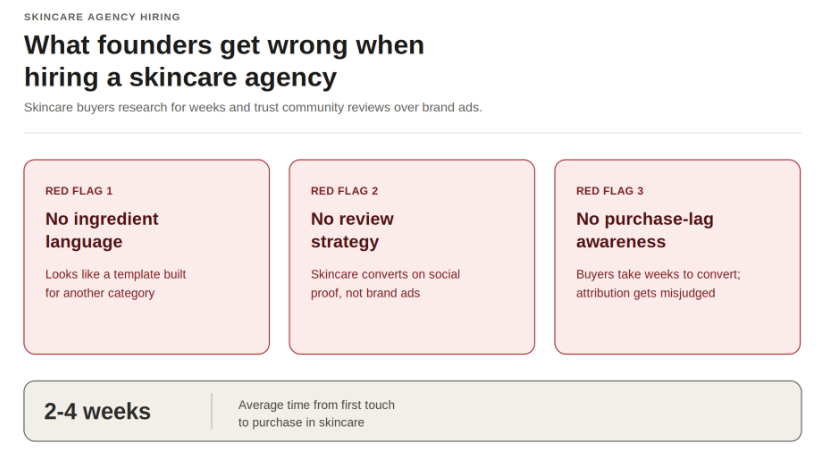
Skincare buyers behave differently than shoe or electronics buyers: they read ingredient lists, compare routines against existing products, and weight community reviews above brand advertising, often researching for several weeks before a first purchase. A generalist e-commerce agency, built to sell running shoes or phone cases with equal ease, tends to miss this research-heavy behavior pattern. A skincare-specialized agency builds campaigns around ingredient transparency and review credibility from the outset, rather than retrofitting a generic playbook.
The three fastest ways to spot a generalist agency mid-pitch:
- No ingredient-level language. If the agency never mentions actives, formulation, or dermatological positioning, they’re likely applying a template built for a different category.
- No review-strategy discussion. Skincare converts on social proof; an agency with no plan for review velocity or UGC sourcing is skipping a core lever.
- No mention of research-to-purchase lag. Skincare buyers often take 2–4 weeks from first touch to purchase; agencies unaware of this will misjudge attribution windows.
Look Beyond Design: Ask About Growth Systems
A storefront redesign does not fix a broken growth engine — founders should evaluate agencies on the full customer journey, including search visibility, pre-purchase content, and post-purchase retention flows, not visual design alone.
Skincare carries one of the highest repeat-purchase ceilings of any D2C category: a working serum or moisturizer gets reordered on a roughly 30-to-60-day cycle as the product runs out. An agency that optimizes only for the first sale leaves this recurring revenue on the table. Before signing, founders should ask specifically what the agency does for subscription flows, replenishment reminders, and loyalty program design — three retention mechanisms that compound over a customer’s first 12 months.
The Rise of AI-Driven Discovery in Skincare
Buyers increasingly ask AI tools direct product questions — such as “what’s the best vitamin C serum for sensitive skin under $30” — and the brands named in those AI-generated answers gain a measurable discovery advantage over brands that don’t appear.
This differs mechanically from traditional SEO. Ranking in an AI answer requires structured, fact-dense content; clear, extractable ingredient data; and a visible presence across the review sites and forums — Reddit threads, Sephora reviews, dermatologist blogs — that AI models draw on when constructing an answer. A brand absent from this layer of the internet is effectively invisible to a growing share of pre-purchase research. Any agency under consideration should be able to explain, specifically, how they structure product and ingredient content for AI extraction. An agency without a clear answer here is behind the shift already underway in the category.
Competitive Movements Worth Watching
Leading skincare brands have shifted 2025–2026 budget away from broad paid social toward influencer seeding, UGC libraries, and community-led content, because reviews now carry more purchase-decision weight than brand messaging.
Private label skincare brands add further pressure: they can replicate a proven formula and undercut on price within a single sourcing cycle, often in under 90 days. A strong agency partner counters this not with lower prices but with brand storytelling and community depth — assets a private-label competitor cannot copy as quickly as a formula.
Benchmarks That Matter More Than Portfolios
Founders should request specific, category-level numbers — realistic customer acquisition cost (CAC) ranges, six-month repeat purchase rate, and product-detail-page (PDP) conversion rate — rather than accepting a generic promise like “we’ll grow your revenue.”
| Metric | What to Ask For | Why It Matters |
| Customer Acquisition Cost (CAC) | Realistic CAC range for your specific price tier (mass vs. premium serum) | Premium actives-based products carry structurally higher CAC than mass moisturizers |
| Six-Month Repeat Purchase Rate | Category-specific repeat rate benchmark, not a generic e-commerce average | Skincare replenishment cycles (30–60 days) should drive higher repeat rates than apparel or accessories |
| PDP Conversion Rate | Conversion benchmark for a well-optimized skincare PDP | Signals whether the agency has actually run skincare-specific landing pages before |
| AI Answer Visibility | Current share of AI-generated answers mentioning comparable brands | Indicates whether the agency tracks this emerging channel at all |
An agency that answers each row of this table with a specific figure has done the category work. An agency that answers only in generalities has not.
Red Flags During the Agency Selection Process
Three warning signs should end a skincare agency evaluation early: guaranteed fast results, an unclear measurement methodology, and an inability to name specific recent skincare trends.
- Guaranteed fast results. Skincare trust builds over a multi-week research cycle; any agency promising rapid, guaranteed growth is misrepresenting how the category converts.
- No clear measurement approach. If an agency cannot explain how it attributes a sale across a 2–4 week research window, its reporting will likely overstate paid channel performance.
- No recent category knowledge. An agency unable to name three specific skincare trends from the past six months — ingredient shifts, formulation trends, platform changes — is not specialized enough to plan a skincare-specific strategy.
A Simple Framework to Choose the Right Partner
Founders can evaluate any skincare agency with four direct questions asked in the first discovery call, and the specificity of the answers is more informative than any portfolio.
- What skincare-specific benchmarks do you track? Look for named metrics (CAC, repeat purchase rate, PDP conversion) with real ranges, not averages borrowed from general e-commerce.
- How do you approach AI-driven search discovery? Look for a concrete content-structuring process, not a vague reference to “SEO.”
- What does your retention strategy look like beyond the first purchase? Look for specifics on subscription flows and replenishment timing tied to product usage cycles.
- Can you show a real growth study, not just a testimonial? Look for named clients, dated results, and measurable before/after figures.
Final Thought
The agencies that grow skincare brands successfully through 2026 and beyond will be the ones treating discovery, trust, and retention as one connected system, not three separate line items on a proposal.
Choosing a partner is not about finding the most polished pitch. It is about finding the team that understands where skincare discovery is heading, into AI-generated answers, community-driven trust signals, and replenishment-based retention, rather than where paid acquisition has already been.
FAQs
1. What makes skincare D2C marketing different from other categories?
Skincare buyers research heavily before purchase, comparing ingredients and weighting community reviews above ads. Marketing has to build credibility before it can convert. Agencies applying a generic e-commerce playbook typically underperform on trust-driven categories like skincare.
2. How important is AI-driven search for skincare brands today?
It is a growing share of pre-purchase research. Buyers increasingly ask ChatGPT, Perplexity, and Google AI Overviews direct product questions before buying, and brands with structured, extractable content appear more often in the resulting answers.
3. What acquisition costs should skincare brands expect?
CAC varies by price point and formulation complexity; premium actives-based serums generally carry higher CAC than mass-market moisturizers. A specialized agency should provide real benchmark ranges for your specific tier rather than a single generic figure.
4. Should skincare brands prioritize retention over acquisition?
Both matter, but retention is more often neglected. Skincare products run out on a predictable 30–60-day cycle, giving the category unusually strong repeat-purchase potential. Agencies building subscription and replenishment flows typically deliver better long-term returns than acquisition-only strategies.
5. How can a brand tell if an agency truly understands skincare?
Ask about recent category trends, real benchmark data, and AI search visibility strategy. Agencies with genuine skincare experience discuss ingredients, review dynamics, and repeat-purchase behavior specifically; generic answers about “driving traffic” signal a lack of category depth.
6. Why are private label skincare brands a growing threat?
Private label competitors can replicate a proven formula and undercut on price within a short sourcing cycle. This pressures established D2C brands to invest in brand loyalty and storytelling, areas a price-focused private label competitor cannot easily replicate.
7. What is the biggest mistake founders make when hiring an agency?
Judging agencies on portfolio polish rather than category expertise. A well-designed website says nothing about growth strategy. Founders should request real benchmarks, recent category insight, and a clear point of view on where skincare discovery and buying behavior are heading.
